

Tiny flying insects hovering around your kitchen or plants are one of the most frustrating household pest problems, and the most common mistake people make is treating the wrong pest. Fruit flies and fungus gnats look similar at a glance, breed in completely different environments, and require different elimination strategies.
Getting the right answer from the start saves weeks of failed DIY attempts.
Gnat vs Fruit Fly: The Quick Difference
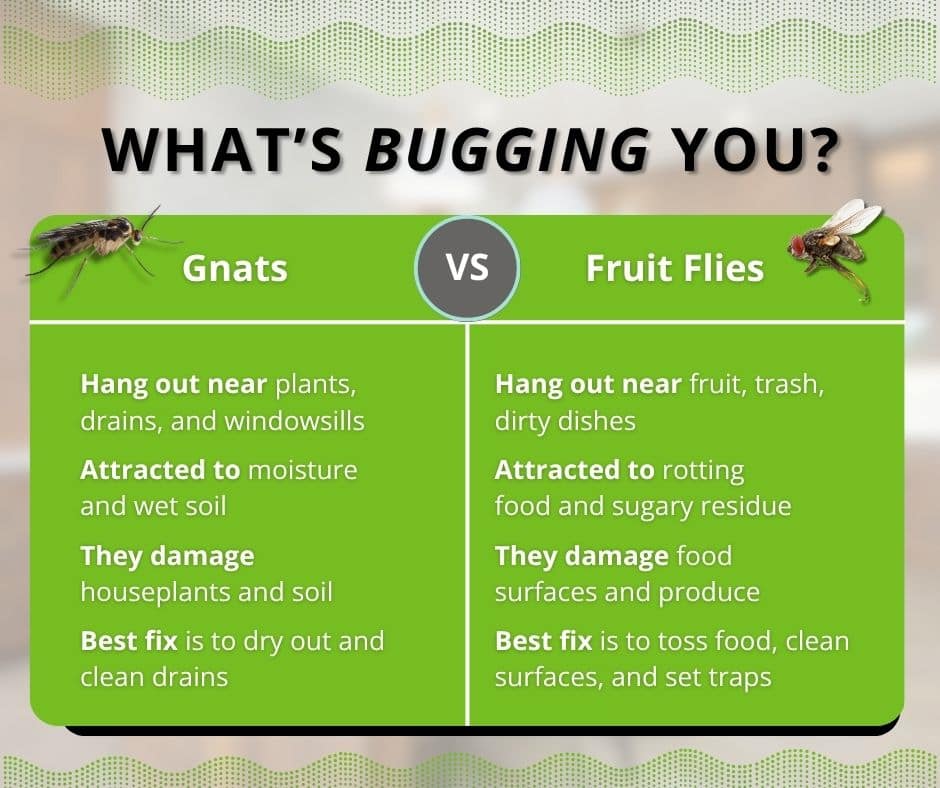
The word “gnat” is a broad, informal term covering many species of small flies. When homeowners refer to gnats as distinct from fruit flies, they almost always mean fungus gnats, a specific species that breeds in the moist soil of houseplants. Fruit flies are a separate species that breed in fermenting organic matter like overripe fruit, drains, and recycling bins.
The simplest way to tell them apart: look at where they are hanging out.
- Bugs hovering near fruit bowls, kitchen counters, trash bins, or drains = fruit flies
- Bugs clustering around plant pots or flying weakly near soil surfaces = fungus gnats
If you need more visual confirmation, here is how their appearance differs.
How to Identify Fruit Flies
Fruit flies are about 1/8 inch long with a compact, rounded body shape similar to a miniature house fly. The most useful identifying feature is their eyes: most common fruit flies have distinctly red or brick-red eyes that are visible if you look closely.
Their bodies are tan to brownish-yellow, sometimes darker toward the rear. Their flight pattern is slow and hovering, often floating lazily near food sources.
| Where They Breed | • Fermenting organic matter (overripe/rotting fruit) • Garbage disposals & sink drain films • Unsealed recycling bins • Soda, beer, or wine residue |
| Peak Season & Entry | • Worst during: Late summer through early fall • How they enter: Open doors/windows or hitchhiking on grocery produce |
| Life Cycle | • Egg to adult: 8 to 10 days (causes rapid population explosions) • Reproduction: A single female can lay up to 500 eggs |
How to Identify Fungus Gnats
Fungus gnats are dark gray to black in color with a slender, mosquito-like body shape. Their long, dangling legs are a distinguishing feature. They are weak fliers with erratic, bouncing flight patterns and rarely fly far from soil surfaces.
Adults are typically found flying just above plant pots, crawling on soil surfaces, or clustering near windows where potted plants sit.
| Where They Breed | • Upper 2–3 inches of moist, organic potting soil • Primary cause: Overwatered houseplants • Larvae feed on soil fungi, algae, and plant roots |
| Peak Season & Triggers | • Worst during: Fall and winter • Triggered by moving outdoor plants inside and indoor heating • Winter watering often exceeds plant needs, keeping soil wet |
| Life Cycle | • Egg to adult: 3 to 4 weeks • Persistence: A longer cycle means infestations are stubborn and slow to clear |
Quick Identification Test
If you are still not sure which pest you have, try this: set a small dish with apple cider vinegar near the problem area. Fruit flies will be drawn to it immediately.
Then check your plant pots: if the soil surface looks damp and tiny black insects are crawling on it or flying up when disturbed, fungus gnats are confirmed.
How to Get Rid of Fruit Flies
Killing adult fruit flies without eliminating breeding sites accomplishes nothing. New adults emerge from the breeding site faster than you kill them.
- Step 1: Remove the source. Throw away any overripe or rotting fruit. Move all fresh produce to the refrigerator. Rinse out and seal all recycling. Empty the trash and replace the bag. These steps cut off the reproduction source immediately.
- Step 2: Clean breeding surfaces. Use a drain brush and enzymatic drain cleaner to break down the organic film in kitchen drains and garbage disposals. Wipe down countertops, around cabinet edges, and under appliances where spills may have accumulated.
- Step 3: Set a vinegar trap. Pour a small amount of apple cider vinegar into a bowl or jar and add a drop of dish soap. The soap breaks the surface tension, and flies that land drown rather than escape. Replace the trap every 2 to 3 days. This catches adults while you eliminate breeding sites.
Realistic timeline: With thorough source removal, fruit fly populations drop noticeably within 48 to 72 hours. Stragglers may continue for another week as any remaining breeding sites are depleted.
How to Get Rid of Fungus Gnats
Fungus gnat control requires interrupting the breeding cycle in the soil, not just killing adults.
- Step 1: Let the soil dry out. Stop watering all affected plants immediately. Allow the top 2 inches of soil to dry completely before watering again. Fungus gnat larvae need moist soil to survive. This alone significantly disrupts the population.
- Step 2: Remove topsoil. Remove the top inch or two of potting mix from infested plants and replace with fresh, sterile potting media. This removes the layer with the highest egg and larva concentration.
- Step 3: Treat with hydrogen peroxide. Mix one part 3% hydrogen peroxide with four parts water and use it to water affected plants. The hydrogen peroxide kills larvae on contact while leaving plant roots unharmed. Repeat once weekly for three weeks to address larvae at different life stages.
- Step 4: Use yellow sticky traps. Place yellow sticky traps at soil level near affected plants. These intercept adult gnats and help monitor how active the population still is.
- Step 5: Consider BTi biological treatment. Bacillus thuringiensis israelensis (BTi) is a naturally occurring soil bacterium that is toxic to fungus gnat larvae but safe for plants, people, and pets. Products containing BTi are available as soil drenches and are effective against larvae without chemical exposure.
Realistic timeline: Fungus gnat infestations take 3 to 4 weeks to clear fully with correct treatment because of their longer life cycle. Consistency is more important than intensity.
Related Questions to Explore
- Can you have both fruit flies and fungus gnats at the same time? Yes. If you have open fruit and overwatered plants, both can thrive at once. Treat them independently: clean kitchen drains/counters for fruit flies, and dry out the soil for gnats.
- Does apple cider vinegar kill gnats? Not effectively. Vinegar traps work great for fruit flies because they love fermenting sugars, but fungus gnats are attracted to soil fungi. It won’t stop a gnat infestation.
- Why do I have gnats but no houseplants? They can breed in any moist, organic environment. Check for leaky pipes, moisture under the sink, clogged drains, or damp areas behind kitchen appliances.
- How long does it take to get rid of fruit flies? Expect a major reduction within 48 to 72 hours of removing all food sources and cleaning drains. Complete eradication can take up to two weeks as the remaining adults die off.
- Are fungus gnats harmful to plants? Adults are harmless, but heavy infestations of larvae can chew on seedlings and young roots. For mature plants, the real danger is overwatering, which allows the gnats to breed.
When DIY Is Not Enough
The University of Maryland Extension provides research-based guidance on fungus gnat identification and treatment.
If you have treated the obvious sources and insects are still appearing in significant numbers after two weeks, the breeding site has not been found or eliminated. Drains with deep organic buildup, hidden moisture under flooring or behind walls, or multiple infested plants throughout a home can sustain populations despite surface-level treatment.
Conclusion
All South Pest Control provides fruit fly and gnat control services that identify all active breeding sites and apply treatment strategies that address the problem at the source. Our technicians can distinguish between fruit flies, fungus gnats, drain flies, and other small flying insects that look similar but require different approaches.
Contact us for an inspection or learn more about our pest control services.

Recent Comments